U.S. MSB Daily News
USMSB.com – Wyoming wants America to believe it just invented a “safe” payment stablecoin.
What it actually launched is something far colder — a limited-recourse money loop wearing a government jersey, wrapped in statute language that reads like a prewritten escape route for the people selling it.
Call it the Frontier Stable Token (FRNT). Call it “first-of-its-kind.” Call it “boring money.”
But don’t call it what it isn’t: a public backstop.
Because once you strip away the patriotic packaging, the design is brutally simple:
- The public supplies the fuel (the dollars).
- The program feeds itself first (operations and buffers).
- The state harvests the narrative win (“we’re the first state!”).
- And the law tells holders, in plain English, not to send the bill to Cheyenne.
If you’re looking for the real collateral behind this “state stablecoin,” it isn’t a Treasury ladder.
It’s the reputation of roughly 588,000 Wyoming residents — people who never agreed to have their state’s name used as the trust amplifier for a product engineered to be legally quarantined from the state’s broader wallet.
That’s the ethical core of the story.
The Motive Problem: A Public Service Brand Running a For-Profit Play
States exist to provide public services, enforce law, and allocate budgets funded by taxpayers.
They are not supposed to behave like a venture studio:
- launch a product,
- market it using public credibility,
- skim prestige and operational discretion,
- then wave a statute when things break.
Yet this is the posture the stable token framework invites.
The “win” is obvious: political prestige (“first state stable token”), institutional narrative power, and the ability to route investment earnings through program accounts under program rules.
The “loss” is engineered to land somewhere else: on intermediaries first, then on market participants, and finally on holders — the people whose dollars keep the machine running.
That’s not innovation.
That’s incentive asymmetry with a government seal.
The Core Trick: State Aura on the Front End, Legal Firebreak on the Back End
A truly public monetary instrument has a real backstop. If it’s public money, the issuer accepts public responsibility.
FRNT is designed to do the opposite:
- Borrow the public aura that makes people think “safer than private stablecoins.”
- Deploy statute-and-rule language that functions like a legal moat: limited recourse, no broad guarantee, defensive liability posture, discretion in stress.
This isn’t a technical debate.
It’s a moral one.
Because the marketing effect of a state label is predictable: retail users — and plenty of institutions — will mentally translate “state-issued” into “state-safe.”
And when something “state-safe” fails, people expect a government-like response.
The paperwork is built to prevent that expectation from becoming enforceable.
Not an accident.
The plan.
The “Self-Circulating” Money Loop: Holders Fund It. Costs Eat First. Nobody Recapitalizes It.
Wyoming’s supporters keep pointing to conservative reserves.
Fine. Conservative collateral is the easy part.
The hard part is the economics — the part nobody wants to say out loud:
This program does not inject meaningful outside capital into the market.
There is no shareholder base that’s forced to eat first loss.
There is no parent balance sheet contractually obligated to refill the tank.
There is no taxpayer backstop by design.
Instead, the machine runs like this:
1) Holders bring dollars in.
Tokens are issued through market rails and intermediaries.
2) Those dollars earn yield.
Treasure-like instruments can generate interest.
3) The program uses that yield to feed itself.
Operations, vendors, audits, compliance, governance overhead, cybersecurity — the boring, expensive stuff — all need oxygen.
4) Only after the machine feeds itself does any “excess” exist.
And even then, “excess” is whatever remains after internal priorities and risk coverage.
That’s why critics call it a “money loop.” Not because it’s a classic Ponzi — but because it is closed-loop finance where the public provides the fuel and the structure ring-fences the downside away from the state’s broader wallet.
It’s a state name operating a self-funding organism.
And when self-funding gets squeezed, the organism does what organisms do:
It protects itself first.
The Peg Isn’t a State Counter — It’s a Middleman Exit
Here’s where the “government stablecoin” starts looking like classic counterparty plumbing.
Under the rules, the system’s main redemption pathway runs through Licensed Service Providers (LSPs) — intermediaries.
That matters because stablecoins don’t fail only because assets are risky.
They fail because exits fail.
In a stress scenario — bank rails freeze, an exchange halts withdrawals, a compliance choke point hits — a token can trade below $1 even if reserves still exist, because the market can’t reach the redemption window fast enough.
That’s how panic works:
- Exits fail first.
- Narratives collapse second.
- Reserves get litigated last.
If Wyoming wants FRNT to behave like “boring money,” it needs something crypto markets don’t offer:
time.
“Licensed Service Provider” Is a Punchline: ‘Licensed’ by Contract, Not by a Regulator
This is where the state’s language does something clever — and dangerous.
“Licensed Service Provider” sounds like “regulated financial institution.”
But the way the term is used and defined in the framework functions more like:
approved counterparty + signed agreement + KYB onboarding
In other words, “licensed” can read as licensed by relationship — not necessarily licensed by a financial regulator in the way normal consumers assume.
That’s not a pedantic point. It’s a risk amplifier.
Because when the public hears “licensed,” they infer:
- stricter oversight,
- stronger controls,
- safer redemptions.
When the legal definition is closer to “the Commission approved them,” you get the worst combination in finance:
confidence-boosting labels + legally narrow meanings.
MSB Risk Warning Sheet: If You Touch FRNT, Here’s What You Inherit
If you’re an MSB, don’t diligence FRNT like a novelty.
Diligence it like a live product that can turn into a customer-complaint firestorm in a weekend.
A) “Licensed” — Licensed Where, Exactly?
- Is the LSP actually licensed as a money transmitter/MSB where required for your flows?
- Are bank-partner or exemption claims documented and defensible?
- If there are multiple entities, which entity is your counterparty — and where is it regulated?
B) Funds Handling & Bankruptcy Reality
- Where do customer funds sit before mint and during redemption?
- Are funds segregated or commingled at the intermediary level?
- If the LSP fails, are customers protected as owners — or treated as unsecured creditors?
C) Redemption Concentration Risk
- How many real redemption pipes exist, and how concentrated are they?
- What happens if the dominant LSP freezes, pauses, or de-banks?
- What is the actual SLA offered to customers, not the theoretical target?
D) Compliance Bottleneck Risk
- Who owns KYC/KYB, sanctions screening, transaction monitoring, and reporting?
- Do you have audit rights and evidence of controls?
- How do you handle Travel Rule and recordkeeping when flows go on-chain?
E) Cyber & Operational Risk
- What is the custody model (keys, signing policy, multi-sig governance, vendor dependencies)?
- How fast is incident response in minutes/hours — not “next meeting”?
- Are reconciliation and change-management controls strong enough for a panic week?
F) Marketing & Disclosure Risk
- Can you explain “state-issued” without implying “state-guaranteed”?
- Are disclosures explicit about no government insurance and no broad public guarantee?
- Are you prepared to police affiliates and promoters who will inevitably oversell the “state” label?
G) Litigation & Reputational Blast Radius
- If customers lose access during a freeze, who do they sue first?
- Even if legal recourse is boxed in, are you ready for the reputational blowback?
- Do you have a customer communications playbook for a de-peg rumor at 2 a.m.?
Translation for MSBs:
FRNT’s biggest risk isn’t Treasury duration. It’s plumbing + perception + panic.
The Time-Bomb Scenario: Rate Cuts + Rising Costs + Public-Sector Slow Hands
Supporters love saying: “It’s Treasuries, so it’s safe.”
That’s freshman comfort.
The real question isn’t “are the assets risky?” It’s:
Can the system survive when the economics and the market collide?
If the Fed moves into a rate-cut cycle, yields fall.
But costs don’t fall on command:
- cybersecurity spend doesn’t go away,
- compliance overhead doesn’t shrink,
- audits don’t get cheaper,
- vendors don’t volunteer discounts,
- incident response doesn’t pause.
Now add the institutional mismatch nobody wants to admit:
Public entities are slow by design. Crypto markets are fast by nature.
A commission has cadence: meetings, approvals, counsel review, procurement rules, public optics.
Crypto has reflex: rumors in minutes, runs in hours.
That mismatch isn’t academic.
It’s a death trap.
Because once the market smells hesitation, it doesn’t wait for a carefully worded statement.
It sells.
And when the state label is part of the story, the sell-off is louder:
“Wyoming’s stable token is wobbling” hits harder than
“some startup’s stablecoin is wobbling.”
The state aura becomes an accelerant.
Who Pays When Humans Fail? That’s the Whole Story
Stablecoins don’t fail only because markets move.
They fail because people make mistakes — and because incentives distort behavior.
Failure modes aren’t hypothetical:
- operational screw-ups,
- custody and key-management errors,
- vendor failures,
- reconciliation glitches,
- compliance choke points,
- moral hazard (“manage optics” instead of managing risk),
- design defects that work in calm seas and jam in storms.
So ask the only question that matters:
Who eats the loss when the human failure hits?
In a properly aligned system, the issuer has skin in the game beyond PR.
Here, the structure is built so the “issuer” can point back to the program’s limited pockets and the program’s own rules.
That creates the worst combination in finance:
maximum trust on the way in, minimum responsibility on the way out.
History Doesn’t Repeat, But It Rhymes — And FRNT Is Writing in Old Ink
America has seen this movie before: public aura used to sell a structure that turns out to be limited-recourse when the math breaks.
Here are the rhymes that matter — not because the facts are identical, but because the failure logic is the same.
Lane 1: Public Glow, Limited Recourse, Private Pain
- WPPSS (“Whoops”): Public affiliation didn’t equal public guarantee — investors learned the difference after the collapse.
- Las Vegas Monorail: Shiny project, ugly outcome — and the “state not liable” language became real when cash flows failed.
- PREPA: “Revenue-backed” turned into years of legal and political trench warfare over what claims were actually worth.
- Jefferson County sewer crisis: Even the most “boring” public project can crater a balance sheet when structure and incentives collide.
- Detroit (2013): When a public system breaks, recoveries become negotiated reality — not the clean story creditors expected.
- Orange County (1994): “Conservative” investment narratives can still blow up when rate math goes the wrong way.
- Harrisburg / Stockton: Project failures and Chapter 9 fights show how quickly “priority” turns into “politics.”
U.S. MSB Daily News nail:
Public names sell confidence. Public documents sell disclaimers. The public learns the difference when the payments stop.
Lane 2: Cash-Like Products + Run Dynamics
- Reserve Primary Fund (2008): A product sold as cash broke the buck — and a run followed because “cash-like” is a promise people test in panic.
- USDC (2023): “Fully reserved” didn’t stop a de-peg when off-chain institutions wobbled — reserves don’t redeem themselves; pipes do.
- Iron Finance (2021) / Terra (2022): Mechanisms and narratives fail at the speed of fear — design assumptions die first in a run.
U.S. MSB Daily News nail:
When the crowd doubts the dollar-ness, the run becomes rational — and the paperwork becomes trivia.
Why Critics Say It’s Built to Fail: Mission Drift + Asymmetry + Speed Mismatch
From a hard-nosed lens, FRNT is built on three misalignments:
- Mission Drift
A public institution is playing product-issuer games without accepting product-issuer consequences. - Asymmetry (“Heads we win, tails you lose”)
Prestige and narrative upside accrue to the state label; tail risk is boxed into the market and intermediaries. - Tempo Mismatch
A commission’s governance clock isn’t built for crypto’s panic clock — especially with redemption routed through intermediaries.
Put them together and the critique lands clean:
Wyoming isn’t injecting stability into the market.
It’s injecting a state label — then selling that label as if it were a balance sheet.
Bottom Line
This isn’t a heroic public service.
It’s a public brand deployed as a trust amplifier for a product the state is structurally motivated not to backstop.
Good deal for the brand when it works.
Bad deal for the market when it doesn’t.
And in finance, when you combine:
- implied safety,
- limited recourse,
- middleman plumbing,
- and governance that can’t move at panic speed,
you don’t get stability.
You get a run — and a lesson people should’ve learned the last time public aura was used to sell limited responsibility.
And One Last Thing: The “Trust” Blog Time-Traveled
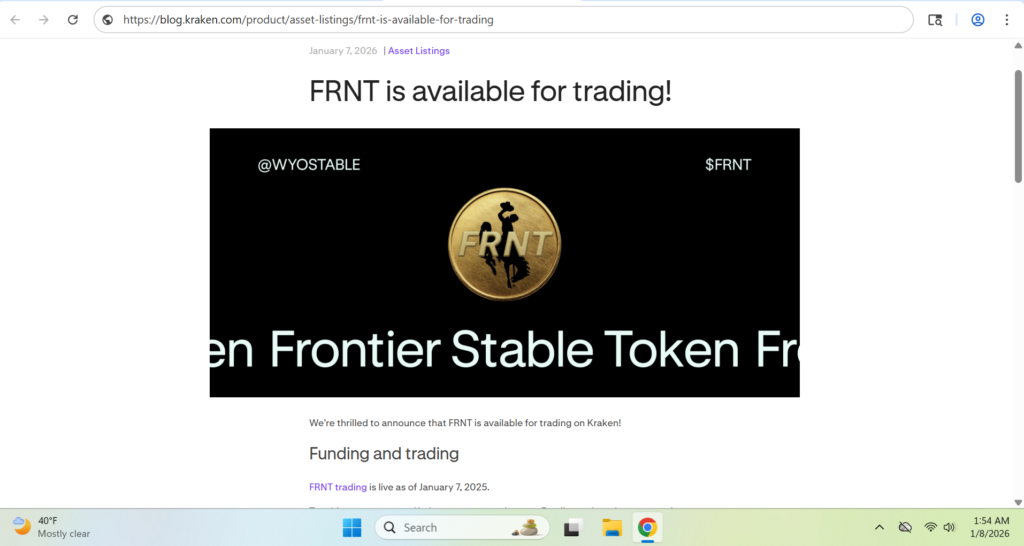
Kraken’s listing for FRNT is dated Jan. 7, 2026 — but it claims trading is live “as of Jan. 7, 2025.”
Maybe it’s a typo.
Or maybe it’s the perfect opener for a project built on trust:
they can’t get the year right on a blog post — but they want you to believe they’ll get redemption math, reserve reconciliation, and crisis communications right when the market panics.
In Wyoming’s stable-token universe, is accountability always postmarked last year?
Related Articles:
- Wyoming’s ‘State Stable Token’ Is a Public-Trust Hijack — A Money Loop Wearing 588,000 People’s Reputation
- From Issuer Logo to Token Icon: Wyoming’s FRNT Visual Narrative Falls Flat.
- Wyoming’s FRNT: One-Exchange Trading, Rising Costs, and an $8.1 Million Budget Request
- Wyoming’s “FRNT” Stable Token: Four Letters, Three Worlds, One Big Headache
U.S. MSB Daily News
Industry News • Regulatory Analysis • Learning Center
Leave a Reply